Mostrando postagens com marcador Last Experiences. Mostrar todas as postagens

quarta-feira, 19 de agosto de 2015

Final de Semana de Circuito no Parque Nacional da Tijuca / A Weekend of Circuits at Tijuca National Park - 14, 15/08/2015.


Final de semana com circuito no Parque Nacional da Tijuca é uma boa pedida, principalmente quando chega um amigo montanhista de fora e você  quer apresentar as montanhas do Rio.

Dia 1- Fomos eu e Anderson Cruz, de São Paulo. Na sexta-feira, fizemos a subida do Pico da Tijuca pela trilha tradicional. 

Vale ressaltar o espetáculo que uma família de macacos pregos proporcionou no meio da trilha. Com a calmaria de poucos visitantes, eles apareceram em bando e estavam em busca de alimentos. Fizemos silêncio e procuramos não causar interferência. Por isso, logo seguimos adiante.

Chegando no cume, céu limpo e sem nuvens, o visual estava espetacular. Aproveitamos para ir até o Tijuca-Mirim, conhecido como um segundo cume da montanha sendo que mais abaixo e menor.
Na descida, resolvemos pegar a trilha em direção às principais grutas do parque.
Silêncio reina na área, o ar gelado e só se ouve os pássaros e folhas que caem com o vento.
Continuamos e resolvemos seguir um caminho até o Morro do Vsconde, de onde se tem uma vista espetacular da Cascata Tayunay (a maior do parque).
Dali, resolvemos tomar direção do Açude da Solidão (travessia que vai sair no Museu do Açude e na estrada do Açude. Já estava escurecendo na mata quando chegamos ao final.
Pra fechar o dia, fomos tomar um Açaí no Tacacá do Norte (Flamengo).

Dia 2 – Resolvemos subir o Bico do Papagaio pela trilha normal. Pra variar, a vista espetacular. Resolvemos descer até o platô chamado de “varanda”. Fizemos uma pausa para descanso e apreciar a vista e as montanhas em volta.

 Na descida, decidimos tomar uma trilha mais longa e interessante: o caminho da serrilha do Papagaio que passa por alguns mirantes e paisagens de tirar o fôlego. A trilha é bem íngreme em alguns pontos , compensado pelas constantes vistas do Pico da Tijuca e outras montanhas do parque.

Terminamos no final de tarde com aquela fome e já pensando nas próximas aventuras.


English

Weekend with a circuit in Tijuca National Park is a good choice, especially when you have a friend who comes from other state  and you want to introduce  the mountains of Rio.


 Day 1 (Friday)- It was me and Anderson Cruz from São Paulo. We made the ascent of the Pico da Tijuca by the traditional route.
It is worth mentioning the show that a family of monkeys nails provided in the middle of the trail. With the lull of few visitors, they showed up in a big famly and were in search of food. We have done quietly and tryed not to cause interference and upset them. So then we went forward.

Arriving at the summit, clean and cloudless sky, the visual was spectacular. We take the opportunity to go to the Tijuca-Mirim, known as a second mountain ridge with more below and smaller.
On the descent, we decided to take the trail towards the main caves in the park.
Silence reigns in the area, the cold air and the only “noise” we could hear were the birds and falling leaves in the wind.
We continue and decided to follow a path up the hill from Visconde, from where one’s have spectacular views of the Cascade Taunay (the main fall and the largest in the park).
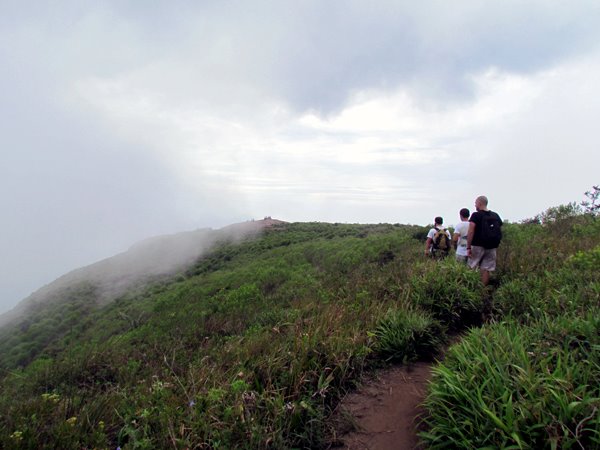
From there, we decided to take the direction of Açude da Solidão - Solitude Dam - (crossing that will come out at the Museum of Açude da Solidão and the road of same name. It was already getting dark in the woods when we reach the end.
To close the day, we went to Flamengo Neighborhood to have an Açai (the best in town).

Day 2 - We decided to climb up the Papagaio”s peak by the normal track. The views were spectaculars for a change. We decided go down to the plateau called "balcony". We paused to rest and enjoy the view and the mountains around.

On the way down, we decided to take a more long and interesting path: the trail of serrilha do papagaio passing by some viewpoints and breathtaking landscapes. The trail is quite steep at some points, rewarded by constant views of Tijuca Peak and other mountains of the park.

We finished in the late afternoon with that hunger and already thinking about the next adventures.

Subida à Pedra Bonita numa sexta de inverno / Pedra Bonita hike up in a winter's day in Rio - 01/08/2015


Numa sexta-feira de inverno, uma subida a Pedra Bonita com Jean, que veio de Curitiba de visita ao Rio e Emerson, baiano-carioca residente no Rio há mais de 10 anos.

O dia estava espetacular: ao mesmo tempo em que estava ensolarado, as montanhas estavam rodeadas por uma neblina densa que deu um ar misterioso às montanhas em volta, principalmente a Pedra da Gávea. Era a primeira vez de Jean e Emerson na Pedra Bonita, e ficaram encantados com o visual e o cume da montanha, que é bem grande e dá vista à esquerda para as praias de São Conrado e a rampa da Pedra Bonita, e em frente o principal: a Pedra da Gávea, montanha granítica imponente com seus 842 metros com a famosa face do Imperador (onde se localiza a famosa travessia dos Olhos para escaladores).

Pra fechar o dia de montanha nada como ir matar a fome. O local escolhido foi um pequeno e tradicional restaurante localizado no bairro de Rio das Pedras. Fechando o dia com um final de tarde no Pier da Barra da Tijuca e um café na Confeitaria Dona Olinda.

English

On a winter Friday, hike up to Pedra Bonita with Jean, who came from Curitiba in a visit to Rio and Emerson, from Bahia and Rio resident for over 10 years.
The day was spectacular: while it was sunny, the mountains were surrounded by a dense fog that gave a mysterious air around the mountains, especially the Pedra da Gávea (Gávea mountain). It was the first time Jean and Emerson in Pedra Bonita, and were delighted with the look and the summit, which is very large and overlooks the left to the beaches of São Conrado and the ramp of Pedra Bonita, and across the principal: the Pedra da Gávea (Gávea mountain): imposing granite mountain with its 842 meters to the famous face of the Emperor (where is located the famous crossing Eye for climbers).


To close the mountain day, there is nothing like going to kill our hunger. The venue was a small traditional restaurant located in Rio das Pedras neighborhood. Closing the day with a late afternoon at Pier of Barra da Tijuca and a coffee  in a Bakery named Olinda (at Barra da Tijuca).

quinta-feira, 11 de julho de 2013

The Cabritos' peak (Goatling peak)

In one of the most beautiful oceanic regions of Rio, painting the sea region of beaches with the contrast of an exuberant green, the Cabritos' peak lies in a small park named Parque Natural da Prainha, as a prolongation of the Pedra Branca State Park, created very recently.


Its rocky wall stands out in the middle of the green rising imponent over the sea below.

In the start of the trail, suddenly comes a very steep ascent scaring even veterans, but relief comes soon and our enthusiasm increases when we find out the trail keeps skirting on the rocky wall.

It is not hard to find nice coloured spiders and serpents in this area. Brilliant beetles is a constant. But the most impressive is the vegetation in the wall that seems like a suspended garden!

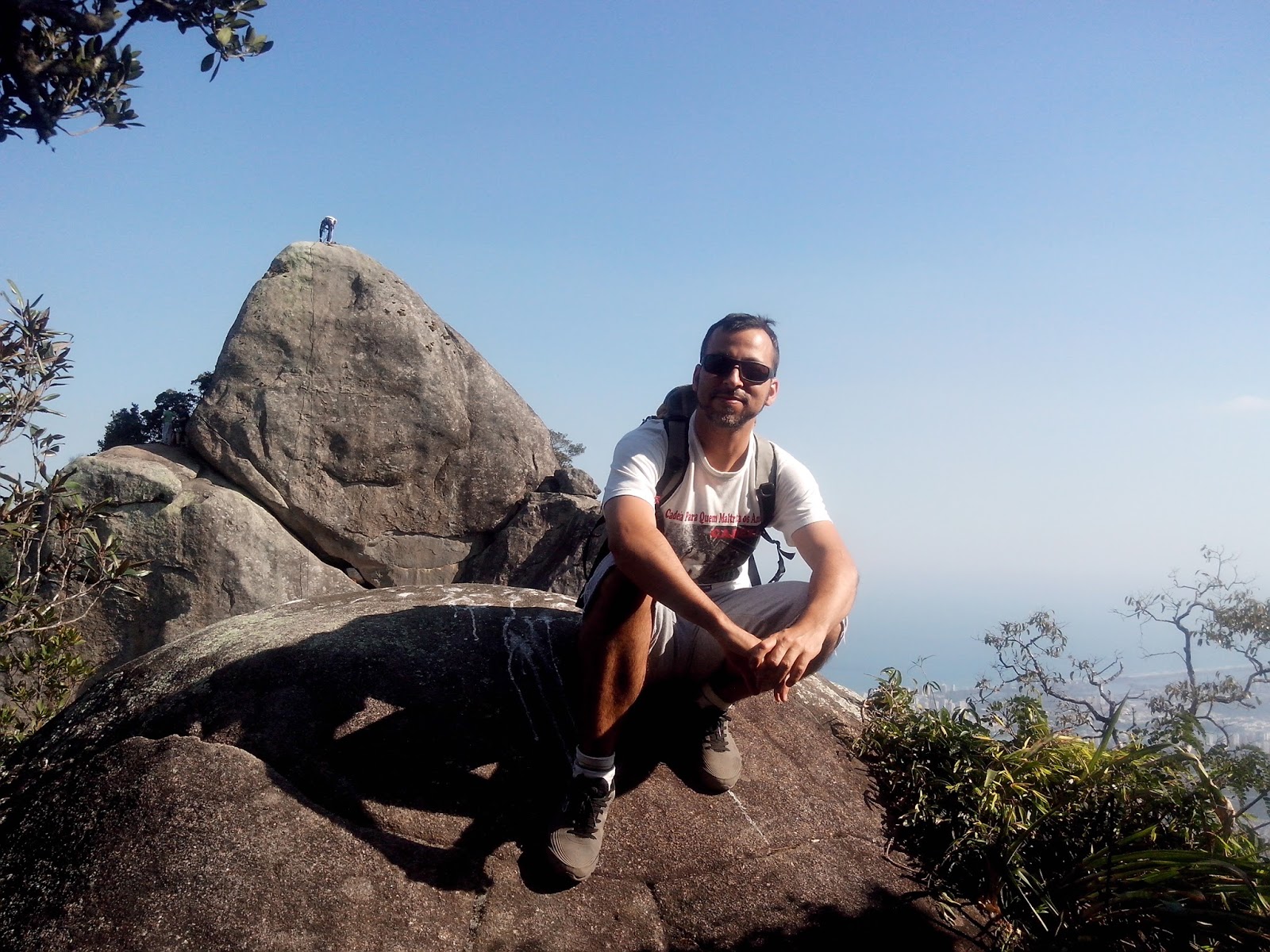
After about 40 minutes hiking up, the trail changes to rock giving us signs that summit is coming. The deep forest takes place to smaller and thorny shrubs. This time is for real! We have to cross an abyss with thorny plants behind. The landscape rises up as an enchant. The summit is amazing! Many cactus and the full oceanic region of view!

sábado, 1 de junho de 2013

Circuito Morro do Archer x Grutas x Ruínas do Humaitá / Loop Hike at Tijuca National Park (Archer hill x Caves of the Forest x Humaitá Ruins

É um dos circuitos que considero mais interessantes no Parque Nacional da Tijuca, pois além de ser feito praticamente todo na sombra, bom para dias quentes de verão, passa por lugares fantásticos como a encosta do Morro do Archer: um paredão abrupto rochoso no meio da floresta úmida e exuberante, onde se observa diversas espécies vegetais interessantes e onde também alguns animais podem ser vistos com mais facilidade. Anfíbios coloridos, grandes borboletas azuis típicas da região, libélulas e macacos pregos são quase certos.


As grutas existentes na Floresta da Tijuca são comumente graníticas, ou seja, foram formadas por desmoronamentos. A mais interessante é a Gruta dos Morcegos, que possui um enorme salão com uma clarabóia que, com a ajuda da temperatura e umidade do seu interior, cria um efeito projetando um bonito feixe de luz no meio a escuridão.
Partindo dali, segue o circuito num constante sobe e desce em direção às ruínas do Humaitá. O caminho passa por um rio e uma belíssima queda d’água, onde dá na conhecida Cascata Gabriela.

A trilha que margeia o paredão rochoso é íngreme às vezes e pouco usado, desemborcando na trilha que leva às grutas já bem conhecidas.


English

It's a circuit that I find most interesting in the Tijuca National Park, as it is done ​​in almost all in shade, good for hot summer days. It goes through fantastic spots as the slope of Archer’s hill: a steep rocky cliff in the middle of rainforest, where we observe various interesting plant species and also some animals which can be seen more easily. Colorful amphibians, large blue butterflies typical of the region, dragonflies and monkeys nails are almost certain.
The trail that borders the rocky wall is steep at times and hardly used, dropping in the beaten trail which leads to the caves.
The caves existing in the Tijuca Forest are commonly granitic: formed by landslides. The most interesting is the Cave of Bats (Gruta dos Morcegos), which has a huge hall with a skylight, with the help of the temperature and humidity inside, creates an effect designing a beautiful beam of light in the darkness.

From thence, the circuit follows in a constant up and down towards the ruins of Humaita. The path passes by a river and a beautiful waterfall, which takes the well known Cascade Gabriela.

terça-feira, 13 de novembro de 2012

Lagoa do Camorim (Pedra Branca)


Chegando na localidade de Camorim, no bairro de Jacarepaguá (Rio de Janeiro), inicia-se uma das mais belas trilhas localizada no Parque Estadual da Pedra Branca. É necessário registrar-se ao parque.

Mata densa, trilha sinuosa e grande parte na sombra da exuberante mata atlântica carioca. Após quase uma hora subindo, em alguns momentos, com vista panorâmica para montanhas do parque, a lagoa surge no meio da mata como por um encanto.

A Lagoa do Camorim é um dos mais interessantes lugares da Pedra Branca. Localizado no meio das montanhas a 436 metros acima do nível do mar, a lagoa é um quarto do tamanho da Lagoa Rodrigo de Freitas (Rio de Janeiro). É uma lagoa única na região, já que não é comum a formação de lagoas em terrenos acidentados como a região da Pedra Branca.

As águas do Açude do Camorim abastecem parte da Zona Oeste do Rio de Janeiro. No total, a trilha dura cerca de 3 horas contando as paradas para descanso e para apreciar as belezas do lugar.

segunda-feira, 12 de novembro de 2012

Camorim Lake (Pedra Branca State Park)


Arriving in the neighborhood of Camorim (lied in t Jacarepagua district (Rio de Janeiro), begins one of the most beautiful trails located in Pedra Branca. State Park You must register with the park to go through this trail.

Dense forest, winding trail and mostly in the shade of lush "carioca" rainforest. After nearly an hour hikinh up, in some moments, with panoramic views of the mountains of the park, the lake appears in the woods as by a charm.

The Camorim dam is one of the most interesting places of Pedra Branca. Located in the mountains to 436 meters above sea level, the lake is a quarter the size of the Lagoa Rodrigo de Freitas (Rio de Janeiro).


It is a single lake in the region, since it is not common lakes formation in terrain as the region of Pedra Branca. The waters of the dam Camorim supply part of the West Zone of Rio de Janeiro. In total, the trail takes about three hours counting stops to rest and to enjoy the beauty of the place.

quarta-feira, 18 de janeiro de 2012

Hiking in Rio: Pedra da Gávea


The “Pedra da Gávea” (Gavea´s peak) lies in Tijuca Natonal Park,  towers to 842 meters of height above sea level and the mountain is well know by the locals hikers.

Surrounded by legends and mystic events, the mountain became a focus for curious writers and researchers attracted by its histories of mystic events alluded to anscient civilizations and even to other planets' habitants.

With the one of the most impressive views of Rio, from the top one can appreciate different angles to all parts of the city, including the mountains and beaches in the other side of Guanabara Bay (Niterói).

The altitude and proximity with the sea coast, make the mountain exposed to the action of time suffering deep erosive processes. The Pedra da Gávea is the largest monolith near a  seashore  in the hole planet. It is well frequented by climbers and has more than 20 climbing routes up to 470 meters long.


"The imense block of granite that rises abruptly from the sea in Rio de Janeiro, impress by its opponency and weird beauty, derived from unusitated shape resembling a big anvil, human face shaped in one side with beards faced to north". - from the book Badhezir, Um ilustre visitante, by Átila Barros, Rio de Janeiro, Brazil.

The trails up to the top are steep and most of the time you hike in the shade. One can observe the wildlife such as birds, rodents (squirrel and raccoons), snakes (coral, pit vipers), lizards and a variety of insects (butterflies, beetles). The greater difficulty of the track is the pitch known as “carrasqueira”, a piece of rock blocks and where you need to use safety equipment for those who are not familiar with the rock. The entire route takes approximately 6 hours (round trip) and requires a good physical preparation, or at least not be a totally sedentary.

Photos by Vagner Pires and Fernando Barroso